Radon Mitigation Systems in Colorado Springs
If a test shows elevated radon in your Colorado Springs property, a mitigation system can help lower it. We design and install effective radon reduction systems across El Paso County, with a focus on quiet operation and clean, tidy installations.
Radon Mitigation performed by Gheorghe Marc, Certified Radon Mitigation Specialist
Colorado radon licence RMT.0000360 · NRPP certification 116070-RMS · verify on NRPP
What this service includes
System design for your property
We plan a system matched to your foundation or basement.
Active soil depressurization
A proven approach that draws radon from beneath the building and vents it safely.
Clean, professional routing
Neat pipe runs and finishes that respect your property.
Verification & maintenance guidance
We confirm the system is working and explain simple ongoing care.
Who needs this service
- Property owners whose test results came back at or above 4.0 pCi/L
- Owners of older or newer buildings who want to lower elevated radon
- Anyone who wants a quiet, reliable, professionally installed system
When mitigation is the right call
The trigger is a measurement. The EPA recommends fixing a home at 4.0 pCi/L or higher and considering action between 2 and 4 pCi/L — if you already have a result, check what your reading means. Without a number there is no way to design a system sensibly, so the first step is a professional radon test rather than an install.
Worth stating plainly: no level of radon is proven safe. 4.0 is the point at which the EPA says act, not a line above which radon is harmful and below which it isn't. Given that El Paso County is Zone 1 and county public health found elevated radon in over 40% of homes tested between 2005 and 2023, an elevated result here is common rather than unusual — and it is a solvable building problem.
How active soil depressurization works
Radon enters because a building sits at slightly lower pressure than the ground beneath it: warm air rises and escapes, and replacement air is drawn in through every crack and penetration in the lowest level. Mitigation reverses that. A suction point is cut through the slab and a sealed pipe connects it to a fan that runs continuously, venting above the roofline. The space under the slab is now the lower-pressure side, so soil gas leaves through the pipe instead of through your floor.
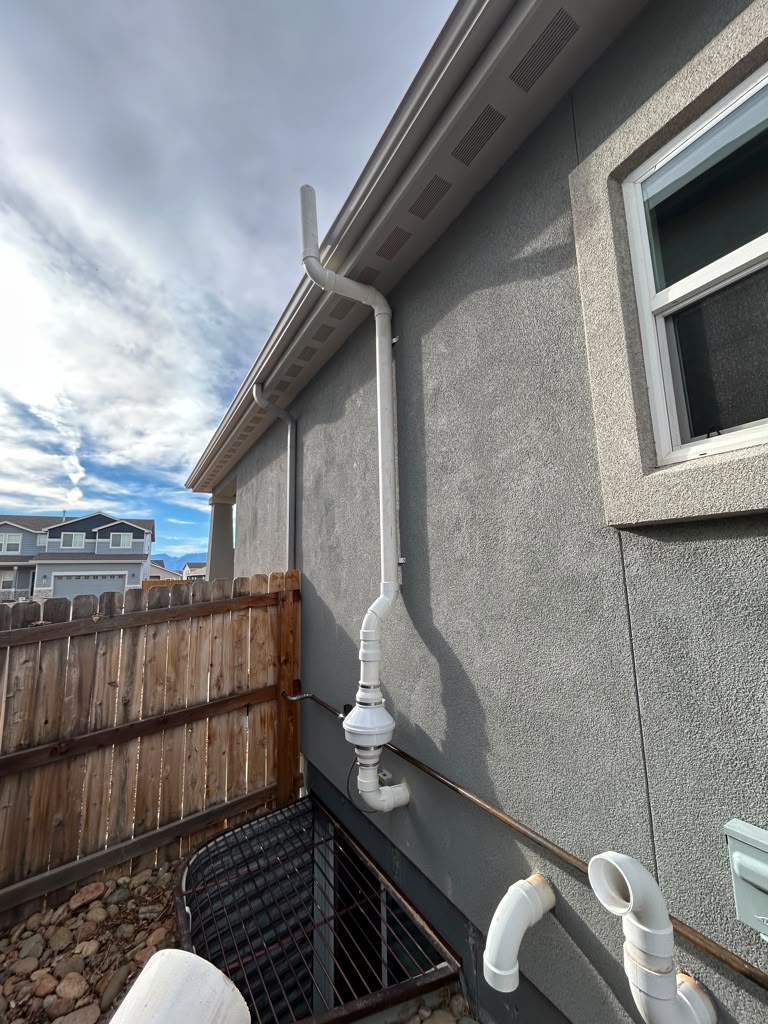
The system intercepts radon before it becomes indoor air — it is not filtering the air you are breathing. Every install carries a manometer so the pressure difference is visible at a glance. The installation photographs show how pipe runs, fan placement and vent terminations look on finished houses.
How the design follows your foundation
Foundation type drives everything, which is why a fixed price from someone who has not seen the building deserves caution. A full basement often needs a single suction point. Slab-on-grade works the same way — a slab is not a radon barrier, since control joints, plumbing penetrations and the perimeter gap all pass soil gas. Walkout and garden-level basements, common through Monument and Falcon, have walls above grade that change both the pressure field and the routing.
Crawl spaces need sub-membrane depressurization instead: a sealed vapour barrier over the soil, with the system drawing from beneath it — the same work as our crawl space sealing and insulation. An open sump pit is a hole straight into the sub-slab and is sealed with a gasketed lid as part of the job; where water is already a problem, combining radon work with sump pump installation and drainage is far cheaper than opening the floor twice.
What affects the cost
CDPHE puts a typical residential mitigation system in Colorado at $1,000 to $2,000 — the state health department's published range, not our price list. What moves a job inside it: how many suction points the slab needs, the distance to a code-compliant vent termination, whether the pipe runs inside or up an exterior wall, whether a crawl space needs a barrier first, and how much finished space has to be worked around.
The cheapest case by a wide margin is a house built with a passive rough-in — a capped pipe already running sub-slab to roof. Activating it means adding a correctly sized fan, because the expensive part is already in the walls. Newer construction around Falcon and Monument often has one; if you see a capped white pipe in your mechanical room, mention it when you call.
Verification, and what we will not promise
Every job finishes with a post-mitigation verification test — the only evidence the system does what it was installed to do, and a written number you keep. The EPA states that radon reduction systems can lower levels by up to 99%, and that is the realistic upper end of what this method achieves.
What we will not do is name the figure your house will land on beforehand, and you should be sceptical of anyone who does. Actual reduction depends on your foundation, your soil, your starting concentration and how the building moves air. If verification comes back higher than the design intended, that is a conversation about additional suction points or fan sizing, not something quietly filed. The follow-up uses the same protocol as an initial radon test.
Living with the system
The fan runs continuously by design. Switch it off, even seasonally, and the sub-slab pressure field collapses within hours. Maintenance is light: if the manometer fluid sits uneven the system is drawing, which is what you want; if the columns are level, the fan has stopped. Retest every couple of years and after anything that changes the foundation or building envelope.
Radon reduction is one part of a healthier building — our indoor air quality page covers where it sits alongside moisture and ventilation. Colorado has required radon professionals to be licensed since 1 July 2022, so ask any contractor for their licence number and NRPP certification, what the vent termination plan is, and whether the verification test is included in writing. We work across Colorado Springs and El Paso County; the certified technician doing the installs is named on this site.
What the published data says about radon in Colorado
Figures from the EPA and the Colorado Department of Public Health and Environment, with sources named.
- 4.0 pCi/L
- The EPA recommends fixing a home when the radon level is 4.0 pCi/L or higher, and considering it between 2 and 4 pCi/L.
- Up to 99%
- The EPA states that radon reduction systems can lower radon levels in a home by up to 99 percent.
- More than half
- Colorado's health department reports that more than 50% of homes in the state test above the EPA's 4.0 pCi/L action level.
- Zone 1
- Zone 1 is the EPA's highest-risk category, meaning the predicted average indoor radon level for the county is above 4.0 pCi/L. Teller, Douglas, Denver and Pueblo Counties are Zone 1 as well.
- ~21,000
- The EPA attributes roughly 21,000 lung cancer deaths per year in the United States to radon exposure, making it the second leading cause of lung cancer overall and the leading cause among people who have never smoked.
- 1.3 pCi/L
- The average indoor radon level in the United States is about 1.3 pCi/L, against roughly 0.4 pCi/L outdoors. Colorado runs well above the national indoor average.
EPA action level
Source: US EPA
Reduction a system can achieve
Source: US EPA, Consumer's Guide to Radon Reduction
Of Colorado homes test high
Source: Colorado Dept. of Public Health & Environment
El Paso County's EPA radon zone
Source: US EPA Map of Radon Zones
US lung cancer deaths a year
Source: US EPA
Average indoor level nationally
Source: US EPA
Simple, Fast, Professional Radon Service
A clear, low-stress process from your first call to a verified, working system.
- 1
Schedule a free consultation
Call or request a free consultation online. We'll set a time that works for you.
- 2
Inspect the property
We look at your foundation, basement, or building to understand how radon enters.
- 3
Test or design the system
We test your level and, if needed, plan a system suited to your property.
- 4
Install the system
Our work focuses on safe routing, tidy finishes, and a quiet, reliable system.
- 5
Verify results & explain care
We confirm the system is working and walk you through simple ongoing maintenance.
Radon Mitigation Systems FAQs
Answers to common questions about this service.
What our customers say
Reviews left by real customers on Google.
Amazing super professionals . Definitely recommend to you guys !
I had a very good experience with AAmerican Radon Solution LLC. Scheduling the radon test was quick and easy, and the technician arrived right on time. They were extremely professional, polite, and respectful of my home. The process was clearly explained, and I received the detailed results super fast. I highly recommend their services to anyone looking for reliable radon testing!
Good prices and very clean and friendly
Excellent! Quality service. Contractor showed up on time and he was really professional. He comunicate all the requirements to us for a proper test. For me, who did this type ot tests countless times I was looking to see if he mentions all the requirements, and he did. This is the first time we are using AAmerican Radon Solution LLC and im very satisfied. I do recommend AAmerican Radon for their services.
Very kind explanation excellent work
Radon Mitigation Systems by location
We provide radon mitigation systems across the Pikes Peak region and the Front Range. Each area page covers the local geology, housing stock, and the radon questions that come up there.
- Radon Mitigation Systems in Colorado Springs
- Radon Mitigation Systems in El Paso County
- Radon Mitigation Systems in Monument
- Radon Mitigation Systems in Fountain
- Radon Mitigation Systems in Manitou Springs
- Radon Mitigation Systems in Security-Widefield
- Radon Mitigation Systems in Falcon
- Radon Mitigation Systems in Peyton
- Radon Mitigation Systems in Woodland Park
- Radon Mitigation Systems in Castle Rock
- Radon Mitigation Systems in Pueblo
- Radon Mitigation Systems in Denver