
February 15, 2026
Radon and Indoor Air Quality: What's the Connection?
Indoor air quality covers everything you breathe inside a building: moisture, ventilation, combustion by-products, particulates, volatile organic compounds and soil gas. Radon belongs on that list, and it has one property none of the others share — it can be measured precisely, for a fixed price, and reduced predictably.
Why radon is the part worth starting with
Most indoor air concerns are hard to quantify. You can suspect humidity, dust or poor ventilation, and improving them is largely a matter of judgement. Radon is different: a 48-hour measurement produces a number in pCi/L, the EPA publishes a threshold to act on, and an engineered system reliably brings the number down.
It is also the one with the clearest health evidence behind it. Radon is the second leading cause of lung cancer in the United States, and CDPHE estimates roughly 1 in 2 Colorado homes have elevated levels. El Paso County Public Health reports over 40% of county homes tested between 2005 and 2023 came back elevated.
So radon is not the whole of indoor air quality. It is the part you can settle with a fact instead of an opinion, which makes it the sensible first move. A flat-rate radon test is $150 and takes about 48 hours.
How radon fits with everything else
The connection between radon and the rest of your indoor air is air exchange — how much outdoor air replaces indoor air, and what the building pulls in when it does.
A heated house sits at slightly lower pressure than the ground beneath it. Warm air rises and escapes at the top, and replacement air is drawn in at the bottom, through the lowest level. That same stack effect distributes whatever it brings in throughout the building.
This produces a genuinely counter-intuitive result. Tightening a house for energy efficiency tends to raise its radon level. Better air sealing, new windows and added insulation all reduce the natural air-exchange rate, so soil gas that enters stays longer and concentrates further. Efficiency work and radon testing belong in the same project.
Moisture, and why it leads underground here
After radon, moisture is usually the next thread to pull, and along the Front Range it usually leads to the same place: the lowest level of the building.
A damp crawl space with exposed soil releases ground moisture into the air continuously, and the stack effect carries that humidity up into the floors above. It is a common reason a house feels musty on the ground floor when the actual cause is under it. The same exposed soil is the largest uncontrolled radon entry point most houses have.
That is why sealing and insulating a crawl space often does more for how a house feels than any appliance, and why it is part of the radon design where a crawl space is involved — the sealed vapour barrier that holds back moisture is the same barrier a sub-membrane depressurization system draws from. Where water is actively getting in, drainage and sump pump work belongs in the same conversation.
What radon mitigation does and does not do
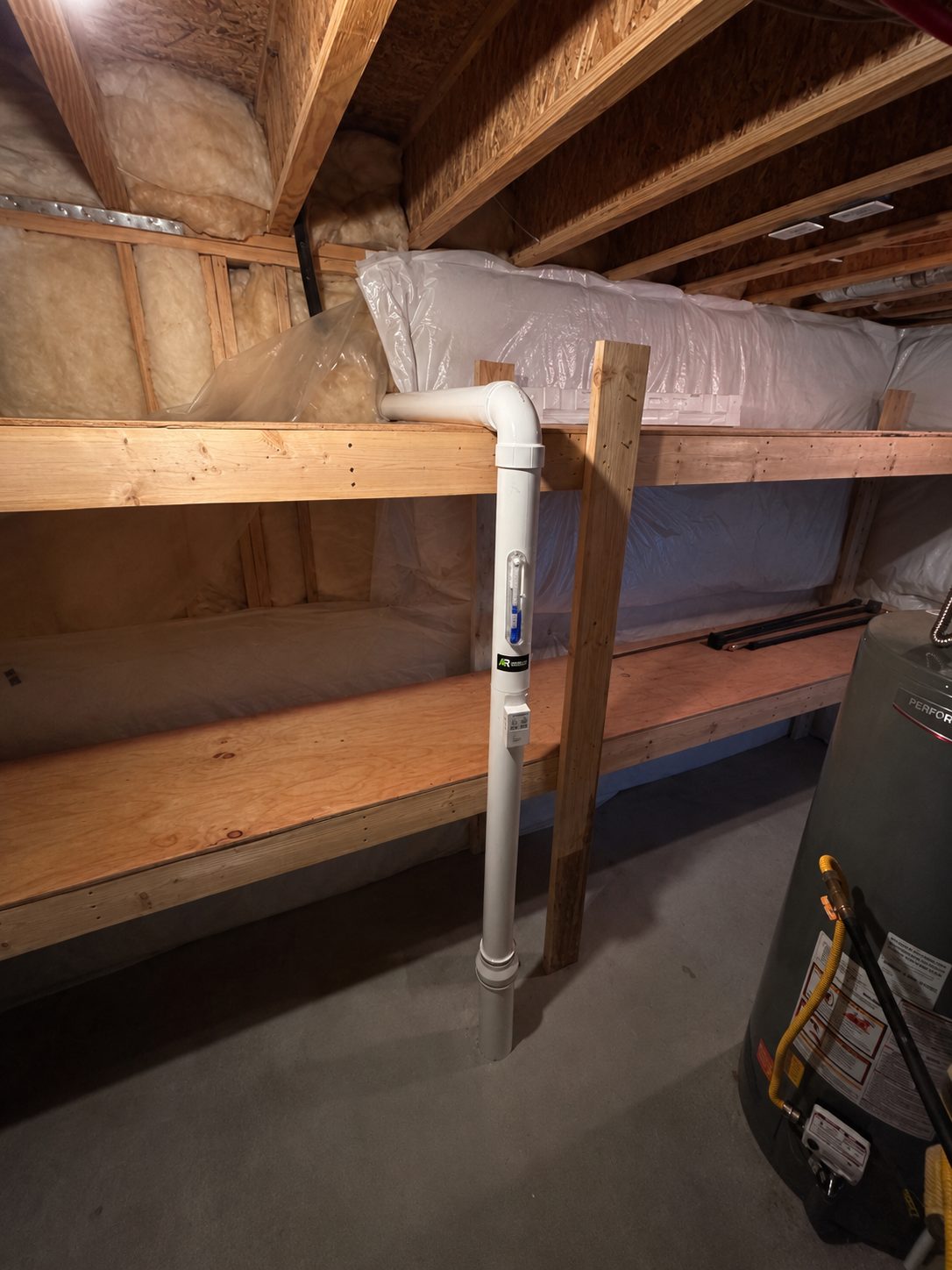
Worth being precise, because it is frequently oversold. An active soil depressurization system intercepts soil gas before it becomes indoor air. It does not filter the air you are breathing, it does not remove dust or allergens, and it is not an air purifier.
What it does do, as a side effect, is depressurise the ground beneath the slab — which also reduces the soil moisture vapour entering with the radon. Houses often feel drier in the lowest level after mitigation. That is a genuine benefit and a real one to expect, but it is a consequence of the design rather than its purpose.
A sensible order of operations
- Test for radon. One number, fixed price, 48 hours. It either identifies a problem worth solving or removes a variable
- Deal with bulk water first if you have any. Laying a vapour barrier over ground that floods traps the water under plastic
- Seal and insulate the crawl space if you have one. Moisture, energy and radon entry all improve together
- Mitigate if the number warrants it. How the system is designed for your foundation
- Then look at ventilation and filtration for the concerns radon work does not address
- Retest after any of it, because changing the envelope changes the number
If you are buying or selling, radon also carries specific disclosure duties in Colorado since 2023 — what sellers, buyers and landlords must provide.