
January 20, 2026
When Should You Test Your Home for Radon?
Testing is the only way to learn your home's radon level, and the answer to “when” is usually now — there is no season or circumstance in which the information is not worth having. That said, some moments make it more urgent than others.
You have never tested
This is the most common situation and the simplest. El Paso County is EPA Radon Zone 1, county public health reports over 40% of homes tested between 2005 and 2023 came back elevated, and you currently have no idea which side of that line your house is on. A flat-rate $150 test settles it in about 48 hours.
Before you finish a basement
This is the timing that matters most and the one people get wrong most often. Finishing a basement does two things at once: it moves your family's daily breathing zone down into the highest-radon part of the house, and it covers over the cracks, joints and penetrations radon enters through.
Test before the drywall goes up. If the level is elevated, installing a system into an open basement is materially simpler and cheaper than retrofitting one into a finished one, where the routing has to work around existing walls and ceilings.
When you are buying, selling or renting out
Colorado tightened its radon disclosure rules in 2023. Sellers and landlords must provide a radon warning statement, hand over any test results and mitigation records they know about, and supply the CDPHE brochure.
For buyers the practical constraint is timing: a valid test needs a minimum 48-hour closed-house measurement period plus 48 to 72 hours for results, so it has to be booked at the start of the inspection period. The full picture for Colorado transactions covers what each party owes the other.
After work on the foundation or the building envelope
Radon entry depends on how your foundation contacts soil and how your house moves air. Change either and the previous result no longer describes the building. Retest after:
- Foundation repair, underpinning or crack injection
- A new furnace, air conditioner or whole-house ventilation system
- Significant air sealing, new windows or added insulation
- An addition, especially one on its own footing
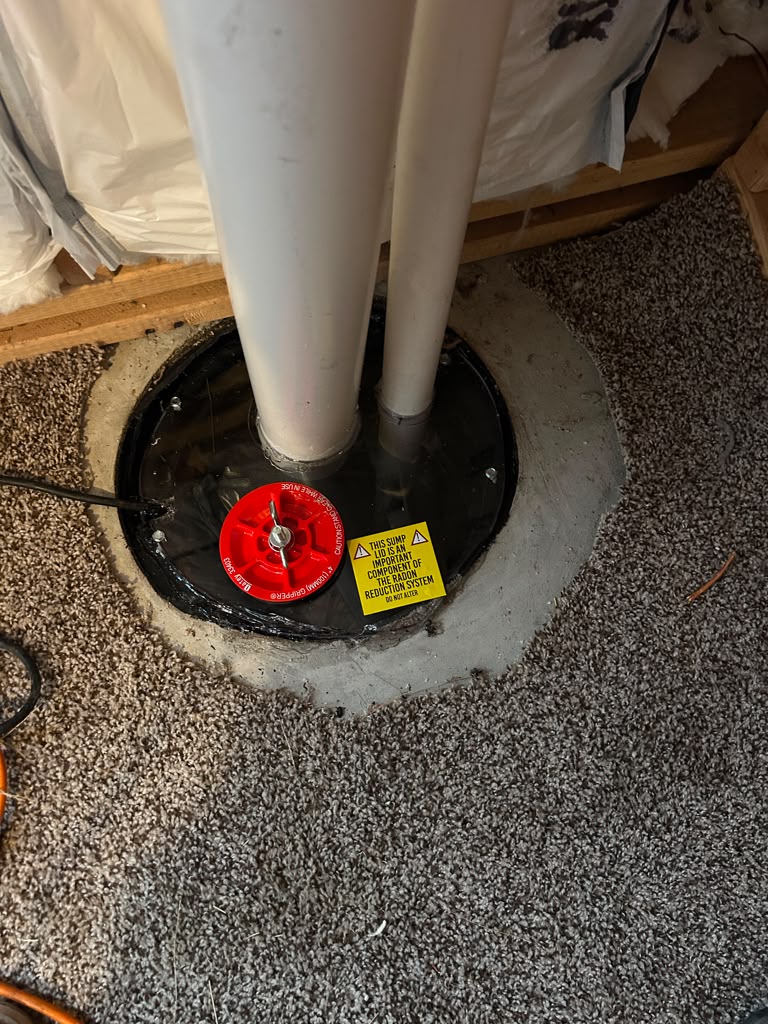
- Installing or replacing a sump pump, or opening the slab for any reason
Tightening a house for energy efficiency is the counter-intuitive one. Better sealing means a lower natural air-exchange rate, so whatever soil gas enters stays longer and concentrates further.
Every two years as a matter of routine
Soil conditions, water tables and the way a house is used all shift over time, and a result from 2019 is a description of a building that no longer exists in quite the same form. Testing every couple of years is inexpensive relative to the certainty it buys.
If you already have a mitigation system, retest on the same schedule. A fan is a mechanical component with a service life, and the only way to confirm the system is still performing is to measure.
Does the season matter?
Any time of year produces useful information, but winter is the more conservative test. A heated house sits at lower pressure than the ground beneath it, and the colder it is outside the harder it pulls soil gas in through the lowest level. The same house often reads higher in January than in July.
That is an argument for testing in winter if you have a free choice — not an argument for waiting. A summer result at 6 pCi/L is still a result at 6 pCi/L, and a mitigation system sized for it will work year-round.
What the test involves
A calibrated detector is placed in the lowest level of the home that is lived in or could reasonably be finished as living space. Closed-house conditions start 12 hours before placement and run through the measurement: windows and exterior doors shut except normal entry and exit, and no whole-house fans or window air conditioners.
The measurement runs a minimum of 48 hours, and the written result normally follows within 48 to 72 hours of collection. If it comes back at or above the EPA's 4.0 pCi/L action level, the next step is a mitigation system designed around your foundation.